What We Believe
The faith of the Ethiopian Orthodox Tewahedo Church, kept for sixteen centuries.
The Holy Trinity
The Church teaches that God is one in three and three in one: three names and one God, three prosopa and one appearance, three persons and one essence. The Father begot the Son without days or hours, and the One was not before the Other. The Father is not greater than the Son, and the Son is not less than the Father; in all that the Son does, the Father and the Holy Spirit are there with Him.
Tewahedo: The Union of Natures
The Church confesses one incarnate nature of God the Word, and does not accept the formula of two natures. Godhead and manhood continue each in its absolute integrity and perfection, without change and without division — perfect God and perfect man in the real sense. This is where the Ethiopian Church, with the other Oriental Orthodox Churches, differs from the Churches that received Chalcedon.
The Holy Scriptures
The Ethiopian canon is the largest in Christendom: 81 books, 46 of the Old Testament and 35 of the New. It includes books kept nowhere else, among them Enoch, Jubilees and 1–4 Meqabyan, and it is read in continuity with the teaching of the apostles and the early Fathers.
The Holy Mysteries
Seven Mysteries mark the life of the faithful: Baptism (ሚስጥረ ጥምቀት), Confirmation or Myron (ሚስጥረ ሜሮን), Holy Communion (ሚስጥረ ቁርባን), Ordination (ሚስጥረ ክህነት), Matrimony (ሚስጥረተክሊል), Penance (ሚስጥረ ንስሓ) and the Unction of the Sick (ሚስጥረ ቀንዲል). They are called mysteries because the invisible grace of the Holy Spirit is granted through them.
Baptism
The Church holds baptism necessary to salvation, on the Lord’s word that unless one is born of water and the Spirit he cannot enter the kingdom of God. Following the law given to Israel, male children are baptised on the fortieth day and female children on the eightieth; a child who is sick may be baptised sooner.
Holy Communion
The Church teaches the real presence: after the blessing the bread and wine are truly turned into the flesh and the blood of the Son of God. This is not a figure or a remembrance only. The sacrament has its root in the Passover of Israel and is the communion of the faithful with God.
The Resurrection and the Judgement
The Church confesses the bodily resurrection of all: those who have done good to the resurrection of life, and those who have done evil to the resurrection of judgement. Salvation is both communion with God now and life eternal to come, and the whole created order is taken into God’s redeeming work.
Veneration, not Worship
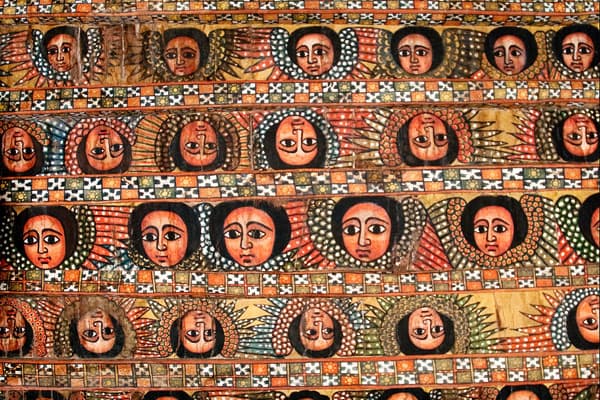
Images of Our Lord, of the Blessed Virgin, of the Apostles, the angels and the saints are not worshipped at all — the Orthodox adore none but God. The honour shown to an icon is directed not to the image itself but to the holy person it represents. This distinction between adoration, which belongs to God alone, and veneration, which is given to the saints, is held firmly.
St Mary, the Theotokos
We honour the Virgin Mary as Theotokos, the true Mother of God, and seek her intercession — as this parish does, dedicated to her Covenant of Mercy, Kidane Mihret.
The Divine Liturgy
The Eucharist is celebrated in Ge'ez, the liturgical language of the Church since the coming of the Nine Saints in the fifth century. What is consecrated is the tabot — the ark dedicated to the church's patron — which rests in the inner sanctuary and is carried in procession on the great feasts.
Fasting and Prayer
The Church keeps seven fasting periods: Wednesdays and Fridays through the year (except the fifty days after Easter), the Great Fast of 55 days, the Fast of Nineveh, the vigils of Christmas and Epiphany, the Fast of the Apostles, the Fast of the Prophets of 43 days, and the Fast of the Assumption of 15 days. There are some 250 fast days in the year, of which the average person keeps about 180. No food or drink is taken before noon at the earliest, and in Holy Week not before one o'clock.
The Communion of Saints
We commemorate the saints, martyrs, and monastic fathers of the Church as living witnesses to the faith, and keep their feast days through the year as occasions of thanksgiving and instruction.
The Books of the Church
Holy Scripture
81 books in all — 46 of the Old Testament and 35 of the New. The Ethiopian canon is the widest in Christendom, keeping books held nowhere else: Enoch, Jubilees, Ezra Sutuel, the Books of Meqabyan, Josephas son of Bengorion, and in the New Testament the Sirate Tsion (Book of Order), Tizaz (Book of Herald), Gitsew, Abtilis, the two Books of Dominos, Clement and the Didascalia.
Metsihafe Kidase — the Missal
The book of the Divine Liturgy. The Ethiopian Church has fourteen Anaphoras, which no other Church possesses, each appointed to its own occasion — among them those of the Apostles, of Our Lord, of St Mary, of St Athanasius, of St Basil, of St Cyril and of St Gregory.
Metsihafe Se’atat — the Book of Hours
The Horologium, composed in the fifteenth century by Abba Giyorgis of Gascha. It carries the prayers of the seven canonical hours, which the faithful are to keep daily.
Digua and the hymnaries of St Yared
The chant books composed by St Yared, the sixth-century deacon of Aksum: Digua, Tsome Digua for the Great Fast, Me’eraf, Zimare and Mewasit. The music sung in every Ethiopian church descends from him.
Weddase Maryam — the Praise of Mary
The Church describes it as a collection of homilies to be read on the festivals of the Virgin. It is divided into seven portions, one for each day of the week, and is among the first books a believer learns to pray.
Arganona Dengel — the Organ of the Virgin
A second collection of homilies in praise of the Virgin, also appointed for her festivals. It is the work of Abba Giyorgis of Gascha, who also composed the Book of Hours.
Nagara Maryam — the History of Mary
A collection of accounts of the life of Our Lady, arranged for the twelve months of the year.
Homilies of the Angels
Homilies setting out the offices of the angels, read on the monthly and annual commemorations of St Michael, St Gabriel and the heavenly hosts.
Mezmure Dawit — the Psalter
The Psalms of David in Ge’ez. Traditionally the first book a child learns in the church school, recited from memory, and the foundation of every hour of prayer.
Senkessar — the Synaxarium
The book of the saints, read through the year so that each day’s commemoration is kept in its place.
Haymanote Abew — the Faith of the Fathers
The patristic collection in which the Church’s teaching is set out in the words of the early Fathers.
Fetha Negest and Kibre Negest
The Law of the Kings, long the legal code of the Church and of Ethiopia, and the Glory of Kings, which carries the account of the Ark and of the Solomonic line.
The Orders of the Saints
The Theotokos
Our Lady is honoured above every creature as the true Mother of God. She is commemorated on the 21st of every Ethiopian month, her Nativity on the 1st and her Presentation on the 3rd, and the Covenant of Mercy granted to her — Kidane Mihret, to which this parish is dedicated — on the 16th. Three books of praise are appointed to her: Weddase Maryam, Arganona Dengel and Nagara Maryam. The fifteen days of Filseta are kept in honour of her Assumption.
The Archangels and the Bodiless Powers
The angels are honoured as those God sends to help and to guard the faithful, and the Church keeps a book of Homilies of the Angels which sets out their offices. St Michael is commemorated on the 12th of every month, with his great feasts on Hedar 12 and Sene 12; St Gabriel, who bore the message of the Incarnation, on the 19th.
The Apostles and Evangelists
Those sent out to preach the Gospel. Peter and Paul are commemorated on the 5th of every month, Thaddeus on the 2nd, John on the 4th, Thomas on the 26th and Mark the Evangelist — first bishop of Alexandria, from whose see Ethiopia received its bishops for sixteen centuries — on the 30th. The Fast of the Apostles is kept for them after Pentecost.
The Martyrs
Those who bore witness to Christ with their blood. St George, martyred under Diocletian for refusing to deny Christ, is commemorated on the 23rd of every month and is among the most beloved saints in Ethiopia, with churches throughout the country bearing his name.
The Monastic Fathers
The fathers who founded the monastic life of Ethiopia and carried the faith into the country. The Nine Saints came from the Eastern Roman world, founded monasteries and translated the scriptures into Ge’ez. Abba Selama — St Frumentius — was consecrated by Athanasius of Alexandria about 330 and is called the Revealer of Light. Abune Tekle Haymanot, founder of Debre Libanos, is commemorated on the 24th, and Abune Gebre Menfes Kidus on the 5th.
Coming to Church
The following is as the Ethiopian Orthodox Tewahedo Church states it.
Shoes are removed before entering the church, and silence is kept there.
The right hand side of each church is reserved for women.
The women’s entrance faces south and the men’s faces north.
It is customary to bow when passing a church at a distance, and when near, to kiss the lintels of the church door.
Covering the head with a netela is the settled custom for women. For what is usual in this parish, ask one of the clergy.
The Seven Hours of Prayer
The faithful are to pray seven times a day. The morning and evening prayers are said in church, especially on Saturdays and Sundays.
- 1On waking, before work
- 2The third hour
- 3The sixth hour, at noon
- 4The ninth hour
- 5Evening
- 6Before sleep
- 7Midnight
Oriental Orthodox Communion
The Ethiopian Orthodox Tewahedo Church shares this confession with the Coptic, Syriac, Armenian, Eritrean, and Malankara Indian Orthodox Churches, together forming the Oriental Orthodox communion — one of the most ancient continuous Christian traditions in the world.